
The Cost of Waiting Another Season
Skip garage door storm prep this year and you're not just risking a dent or a jammed track. A door that fails under wind pressure can blow inward, and once that happens, wind gets inside the house and pushes up on the roof from underneath. That's how a storm turns a bent panel into a torn-off roof and water damage throughout the garage and anything stored near it — tools, a second vehicle, holiday decorations, sometimes a freezer full of food. Replacing a garage door after the fact, plus drywall, insulation, and roof repair, costs far more than reinforcing or replacing the door now. And during storm season, getting a contractor out fast is harder than it sounds when every garage door company in Lake County is booked solid.
Why the Garage Door Fails Before Anything Else
Exterior walls are built with studs, sheathing, and fasteners spaced to resist uplift and lateral pressure. A garage door is a large panel of thin steel or aluminum, hinged in sections, held in place by tracks and rollers, and pushed against the frame mostly by its own weight and a center lock. It's the single largest opening in most homes, and it's engineered to move, not to resist force the way a wall does. When wind hits the front of a house, pressure builds on that door; when wind wraps around the sides or the roof, the pressure can shift so that the door gets sucked outward instead of pushed in. Either way, if the track, rollers, hinges, or panel aren't rated for the load, the door buckles, pops off the track, or separates at a hinge — and once one section gives, the rest follows fast.
In this part of Florida, that risk is compounded by what the humidity and salt air are already doing to the door year-round. Moisture swells wood-trim doors and makes steel panels rust at the bottom corners and along hinge points. A door that's already weakened by rust or swelling has far less reserve strength when a real wind load hits it.
Signs Your Door Won't Hold Up
- Visible rust at the bottom panel, hinges, or track brackets — rust thins the metal exactly where stress concentrates.
- Panels that don't sit flush or have slight warping from humidity swelling — a gap here means wind can get a grip on the edge.
- Loose or bent track anywhere along its length — even a small bend reduces how much lateral force the door can take before it jumps the rollers.
- A center lock or no lock at all — many older doors rely only on the opener's lock mechanism, which is not rated for wind load and can shear under pressure.
- Cables that look frayed or stretched — these keep the door under control if a spring lets go during a storm-driven power outage.
What Actually Helps Before Wind Season Peaks
- Check or add wind-load bracing. Many doors built to current wind-load standards already have horizontal struts on the back of each panel. Older doors often don't. Retrofit strut kits reinforce the panels so they flex less and distribute pressure instead of buckling at one point.
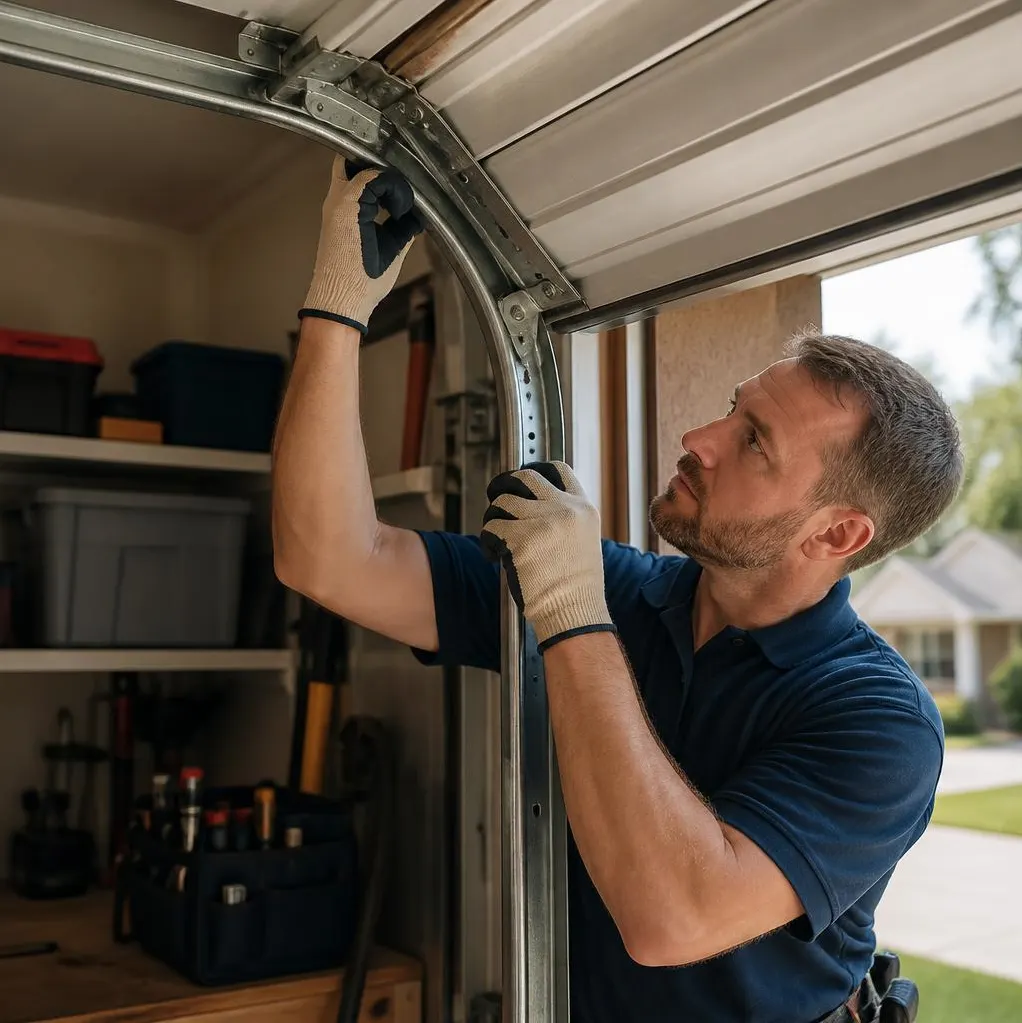
- Inspect and replace worn rollers and track. Nylon rollers in poor condition let the door shift more inside the track, which is exactly what you don't want when wind is pushing on it. Bent track should be replaced, not hammered back into shape — a straightened track rarely holds alignment under real load.
- Test the springs under load, not just by eye. A spring that's lost tension makes the opener work harder and can fail during the exact moment you need to close the door quickly ahead of a storm. If the door feels heavy when lifted manually with the opener disconnected, the springs are past due.
- Make sure cables aren't frayed. If a spring breaks during a power outage, the cables are what keep the door from crashing down or flying open uncontrolled.
- Add or verify a center and side lock. If you'll be manually locking the door ahead of a storm, confirm the mechanism actually engages solidly into the track, not just into thin sheet metal.
- Keep the opener on a battery backup if you rely on it to close the door during outages that often follow afternoon storms and tropical systems here.
Reinforce or Replace: The Honest Trade-off
If the door itself is solid steel with no rust-through and reasonably new, a bracing kit plus fresh rollers and cables is usually the more economical route, typically a few hundred dollars in parts and labor. If the door is older, visibly rusted at the bottom, or already out of alignment from years of humidity swelling, reinforcing it is putting new hardware on a weak panel. In that case, full replacement with a door rated for wind load is the safer long-term move, generally running from the low thousands up depending on size, material, and insulation — but it comes with an opener-compatible, code-appropriate door instead of a patched-up older one.
When to Call Precision Garage Door of Umatilla
If you're hearing scraping when the door moves, seeing rust at the bottom panel, or you're just not sure your door has any wind-load reinforcement at all, that's the time to get it looked at before storm season peaks, not during an active watch. Precision Garage Door of Umatilla handles garage door tune-up and maintenance checks that catch worn rollers, loose track, and failing cables before they become a storm-day emergency, and we also handle full garage door installation and replacement if your current door isn't built for the wind load this area sees.
If you're anywhere in Umatilla, Eustis, Mount Dora, Tavares, Leesburg, Lady Lake, Altoona, or Apopka and want your garage door checked before the next storm rolls through, call Precision Garage Door of Umatilla today.